
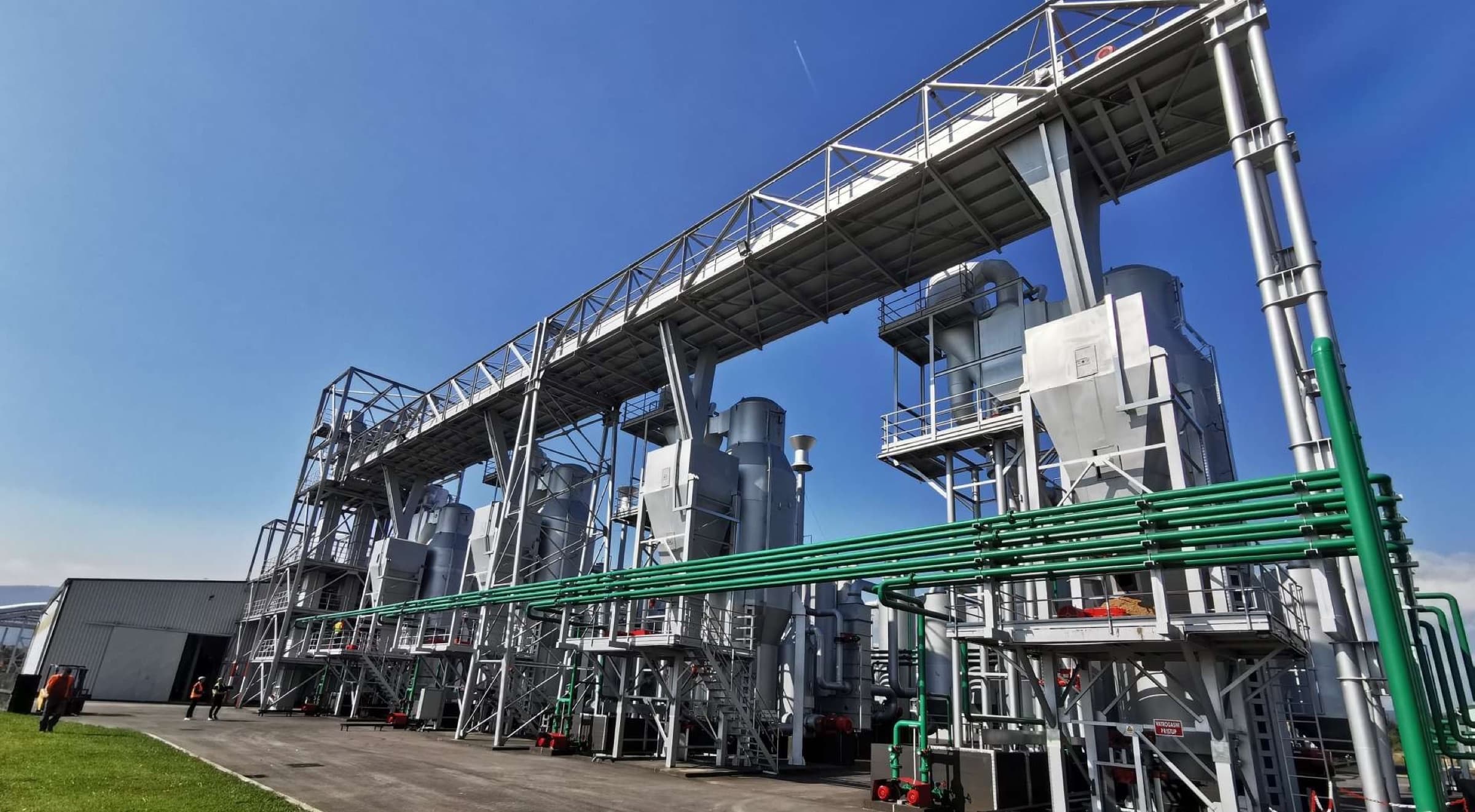
Most people picture a biomass power plant as a large boiler: burn wood, raise steam, spin a turbine. That is one way to do it, and it is how many older plants work. Gasification takes a different route, and it is the reason a modern modular plant can produce several products at once from the same fuel.
This guide explains what happens inside, without the chemistry lecture.
Burning versus gasifying
When biomass burns in plenty of air, its carbon and hydrogen combine fully with oxygen. The energy comes out as heat, and almost all the carbon leaves as carbon dioxide. What remains is a little ash.
When biomass is gasified, it is heated with a deliberately limited supply of air. There is not enough oxygen to burn it completely, so instead it breaks down into a fuel gas — often called producer gas or syngas — made mainly of carbon monoxide, hydrogen, some methane, carbon dioxide and nitrogen. That gas still contains most of the fuel's energy, but now in a form that can be cleaned, piped and used flexibly.
Not all the carbon is converted. Part of it stays behind as a solid char — biochar.
What happens inside the gasifier
Inside the reactor, the biomass passes through several zones as it heats up:
- Drying. Remaining moisture evaporates.
- Pyrolysis. Without enough oxygen to burn, the biomass breaks down into vapours, tars and char.
- Oxidation. A controlled amount of air burns part of the material, supplying the heat that drives the other stages.
- Reduction. Hot char reacts with carbon dioxide and water vapour to form carbon monoxide and hydrogen — the useful fuel gas.
The design of the reactor — how fuel and air move through it, and at what temperatures — determines the gas quality, the amount of tar and the quantity and quality of biochar produced.
Cleaning the gas
Raw gas leaving the gasifier carries dust, tars and moisture. Engines and upgrading equipment need clean gas, so the next stage cools it and removes contaminants through a combination of cyclones, filters, scrubbers and coolers.
This is the stage that separates reliable plants from unreliable ones. Tars that condense in the wrong place foul engines and pipework. A well-designed cleaning train, operated properly, is what lets a gasification plant run around the clock.
Three ways to use the gas
Once cleaned, the gas can be used in several ways — sometimes more than one at the same site:
- Electricity. Gas engines drive generators, producing continuous power. This is the most common use in onsite plants.
- Heat. Heat recovered from the engines and the gas stream supplies steam or hot water. The gas can also be fired directly in kilns, dryers and boilers.
- Renewable gas. The gas can be further processed and upgraded to synthetic natural gas that meets pipeline specifications. See biomass to synthetic natural gas.
Where biochar comes in
Because gasification leaves part of the carbon unconverted, every tonne of fuel yields a quantity of biochar. Biochar is a stable form of carbon: it resists breaking down for very long periods. When it is used in soil, concrete or other durable applications, the carbon that the original plants drew from the atmosphere stays out of it.
That is why a gasification plant can be carbon-negative: it generates renewable energy and, at the same time, stores carbon in a measurable, verifiable form. See how biochar carbon removal is measured.
Why gasification suits modular onsite plants
Gasification has characteristics that fit distributed generation well:
- Scale. Gas engines are efficient at the 1–20 MW scale typical of industrial sites, where large steam turbines are not.
- Flexibility. One gas stream can serve power, heat and gas uses.
- Modularity. Gasifiers, cleaning trains and engines can be built as standard modules and combined.
- Carbon. Biochar production is built into the process rather than bolted on.
What makes a plant reliable
Buyers and lenders often focus on the gasifier itself. In practice, reliability depends on the whole system:
- Fuel preparation — consistent size and moisture. See assessing your feedstock.
- Gas cleaning — designed for the tar and dust levels of the chosen fuel.
- Controls — automated control of fuel feed, air and gas quality.
- Operations — trained operators, remote monitoring, planned maintenance and spares on site.
How CNP builds plants
CNP plants are modular gasification systems that convert local biomass into continuous power, heat and renewable gas, with biochar recovered alongside. They are financed, built, owned and operated by CNP under long-term energy agreements. See Technology.
Next step
Talk to an engineer about your site, your fuel and what a plant could supply.

.jpeg&w=3840&q=75&dpl=dpl_8omWQr2dmx9eNa5YGxR721ZE6K6N)